
Gas Detection for Wastewater Treatment Plants
Wastewater treatment facilities operate at the convergence of biological chemistry, confined-space risk, and strict environmental regulation. Facility managers and municipal engineers here contend with a gas hazard profile that shifts by process zone: methane building in wet wells, chlorine off-gassing near disinfection dosing points, oxygen displacement in enclosed digester galleries. Managing that profile requires more than off-the-shelf detectors; it requires a monitoring architecture matched to how each zone behaves. Generic solutions fail here.
Custom gas detection systems address these challenges by pairing the right sensor technology to each hazard. Electrochemical sensors deliver the sensitivity needed for chlorine and ammonia; infrared and catalytic-bead technologies handle methane and combustible gas ranges. Understanding the tradeoffs between these approaches is covered in detail on our gas detection methods page. Early-warning integration across zones keeps workers informed before conditions become immediately dangerous.
The San José Environmental Services Department reports the San José-Santa Clara Regional Wastewater Facility treats an average of 110 million gallons per day, with capacity reaching 167 mgd. At that throughput, manual spot-checking is not a viable safety strategy: continuous, automated monitoring is the only operationally realistic option.
MDC Systems' factory-trained technicians design and commission LEA-approved systems built for wastewater environments. Schedule a facility safety assessment or discuss your monitoring layout; explore our gas detection system installation services to see how we approach turnkey projects.
Critical Gas Hazards in Wastewater Treatment Environments
Methane accumulation in enclosed structures, oxygen deficiency in confined spaces, carbon monoxide from engine-driven equipment, and ammonia from chloramine disinfection chemistry represent the foremost atmospheric hazards that operators must manage across a typical plant. None of them announce themselves; they require fixed-point detection with alarm thresholds calibrated to the specific exposure limits and process conditions of each area. Hazards persist around the clock.
Safety infrastructure in this environment is also a commercial asset. Unplanned shutdowns for post-incident investigation, regulatory penalties, and the labor cost of manual monitoring substitution all carry real dollar values. MDC Systems industry solutions are designed to minimize total cost of ownership while keeping detection coverage continuous and code-compliant.
Process-Specific Gas Monitoring Across Sewage Treatment Operations
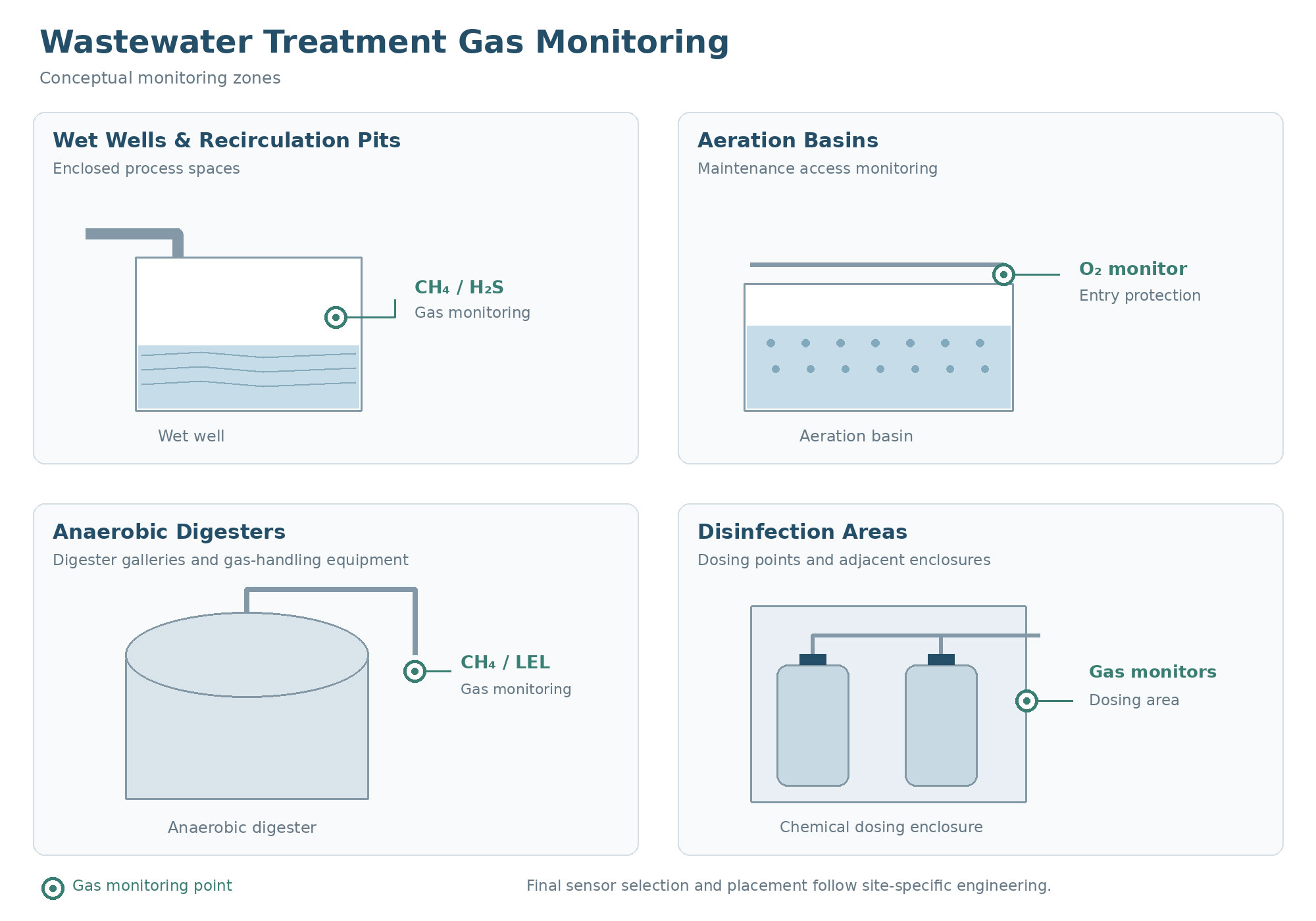
Each process zone generates a discrete hazard profile, and sensor placement should reflect that. Placement dictates performance.
Wet Wells & Recirculation Pits:
Methane and hydrogen sulfide accumulate rapidly in these low-lying, enclosed spaces, making fixed LEL and H2S monitors standard.
Aeration Basins:
Oxygen depletion during maintenance access requires continuous O₂ monitoring before and during confined-space entry.
Anaerobic Digesters:
Methane production is the primary hazard; per the California Regional Water Quality Control Board NPDES permit, anaerobic digestion biologically breaks down organic matter and sewage sludge to produce methane and other biogases for energy recovery, making fixed combustible gas detection non-negotiable in digester galleries.
Disinfection Areas:
Sodium hypochlorite and ammonia are metered together to form chloramines; both require dedicated electrochemical monitoring at dosing points and in adjacent enclosed areas (per the California Regional Water Quality Control Board NPDES permit).
Engineering Compliance and Safety Outcomes
Under NPDES permits, total residual chlorine must be monitored continuously and recorded at least every five minutes, with analyzers validated against grab samples (per the California Regional Water Quality Control Board NPDES permit). A one-hour average effluent limit of 0.013 mg/L at the discharge point to Artesian Slough leaves practically no margin for instrument drift or gaps in coverage. Compliance is unforgiving.
When a continuous chlorine analyzer goes offline for more than an hour, the permit requires manual grab sampling substituted hourly (per the California Regional Water Quality Control Board NPDES permit). A reliable, redundant fixed detection system eliminates that labor burden and keeps the facility out of a reactive compliance posture.
Turnkey Gas Detection Solutions for Wastewater Treatment Facilities
MDC Systems manages the full project scope: system design, equipment selection, professional installation, commissioning, and ongoing maintenance, utilizing licensed engineers and factory-trained technicians at every stage to ensure complete compliance. Every system is engineered for LEA approval and built around the specific process chemistry and spatial layout of the facility.
Fixed area monitors cover process zones continuously, but confined-space entry into wet wells or digester galleries requires a complementary layer of protection. A hybrid approach, combining fixed detection for ambient monitoring with personal portable instruments for pre-entry and in-space use, closes the coverage gap that fixed-only systems leave open. Safety requires redundancy.
Representative Scenario: A municipal facility upgrading its mesophilic anaerobic digesters from floating to fixed covers faces a changed methane containment profile during and after construction. Fixed combustible gas detectors positioned at the digester gallery ceiling and gas-handling equipment, integrated with the facility's SCADA system, provide continuous LEL monitoring without false-alarm fatigue. The result is a system that meets regulatory requirements from day one of fixed-cover operation and requires no manual workaround during the transition period.
Schedule a professional safety layout assessment with MDC Systems. We evaluate sensor placement, alarm setpoints, and redundancy requirements against your facility's specific process map, not a generic template.
Regional Standards and Environmental Compliance in San Jose
The San José-Santa Clara Regional Wastewater Facility operates under NPDES Permit CA0037842, which sets a one-hour average total residual chlorine effluent limitation of 0.013 mg/L at Discharge Point 001 to Artesian Slough (per the California Regional Water Quality Control Board NPDES permit). Meeting that limit requires continuously calibrated analyzers, not periodic checks, because the chemistry at the discharge point can shift faster than a manual sampling schedule can track.
The facility is currently implementing a $1.4 billion, 10-year Capital Improvement Program to rebuild aging infrastructure, including digester cover upgrades (per the San José Environmental Services Department). That scale of modernization means new methane monitoring requirements are being engineered into facilities that previously operated under different containment assumptions. Modernization demands vigilance.
Frequently Asked Questions About Wastewater Gas Detection
Sensor technology is matched to the target gas: electrochemical sensors for chlorine and ammonia, catalytic-bead or infrared sensors for methane and other combustibles, and electrochemical or galvanic sensors for oxygen deficiency. For a detailed breakdown of detection principles, see what detects a gas leak.
Wastewater environments are among the most demanding for sensor durability. High humidity accelerates electrolyte degradation in electrochemical sensors and can introduce moisture interference in catalytic-bead elements. Regular calibration by factory-trained technicians, verified against known gas concentrations, is the only reliable way to confirm sensors are reading accurately rather than drifting silently.
Under NPDES permit requirements, if a continuous chlorine analyzer is offline for more than one hour, the facility must substitute manual grab sampling on an hourly basis (per the California Regional Water Quality Control Board NPDES permit). That obligation falls on operations staff immediately and continues until the analyzer is restored. Downtime is costly.
Anaerobic digestion produces methane and other biogases as organic matter breaks down (per the California Regional Water Quality Control Board NPDES permit). Transitioning from floating to fixed covers changes the gas accumulation profile inside the digester structure: fixed covers create enclosed headspaces where methane can concentrate, requiring fixed combustible gas detectors positioned and calibrated for the new containment geometry.
Reclaimed water from wastewater treatment facilities can serve as feedstock for clean hydrogen production. The California Public Utilities Commission has documented this pathway for facilities such as the City of Lodi's plant, illustrating how wastewater infrastructure is becoming an active participant in regional energy transition planning.
Contact Us Today
Maintaining detection accuracy over the long term requires a structured calibration and testing program. MDC Systems provides ongoing gas detection calibration and maintenance services to ensure operational continuity and keep your wastewater facility's monitoring systems code-compliant. Reach us at 408-370-5005 in San Jose, CA.