
Gas Detection Systems for Semiconductor Fabs
Semiconductor manufacturing operates under safety and environmental constraints that most industrial sectors never encounter. Modern fabs run on a continuous supply of specialty gases, including silane for CVD deposition, phosphine and arsine for doping, hydrogen chloride and fluorine for etching. Each of these materials carries a hazard profile that general-purpose industrial safety infrastructure was never built to handle. For facility managers and EHS directors in Santa Clara County, the operational tension is specific: maintain absolute personnel protection and regulatory compliance without triggering false alarms that evacuate cleanrooms, halt tools, and destroy wafers mid-process.
The chemistry compounds the challenge. Silane is pyrophoric and ignites spontaneously on air contact, making silane gas hazards a primary concern in any credible fab safety program. Phosphine and arsine are acutely toxic at concentrations well below the threshold of human sensory detection, which means sub-ppm monitoring is the only reliable line of defense for personnel. Off-the-shelf industrial detectors lack the sensitivity, selectivity, and system integration architecture that semiconductor cleanrooms and sub-fabs demand. Cal/OSHA Title 8 HPM standards and Santa Clara County municipal fire codes require continuous, high-precision monitoring, not periodic spot checks.
Unplanned cleanroom downtime is expensive in ways that accumulate fast. Every second counts. Industry consensus among fab operations professionals holds that even a brief, unplanned production halt in a high-volume facility can translate into hundreds of thousands of dollars in lost wafer yields, disrupted tool schedules, and supply chain delays. A properly engineered Gas Life Safety System (GLSS) is the infrastructure that prevents those events from occurring in the first place.
MDC Systems designs and installs custom gas life safety systems built specifically for semiconductor and advanced manufacturing environments in the San Jose region. To schedule a technical review of your gas cabinet, VMB, and exhaust monitoring configuration, contact MDC Systems directly.
The Critical Role of Gas Detection in Semiconductor Manufacturing
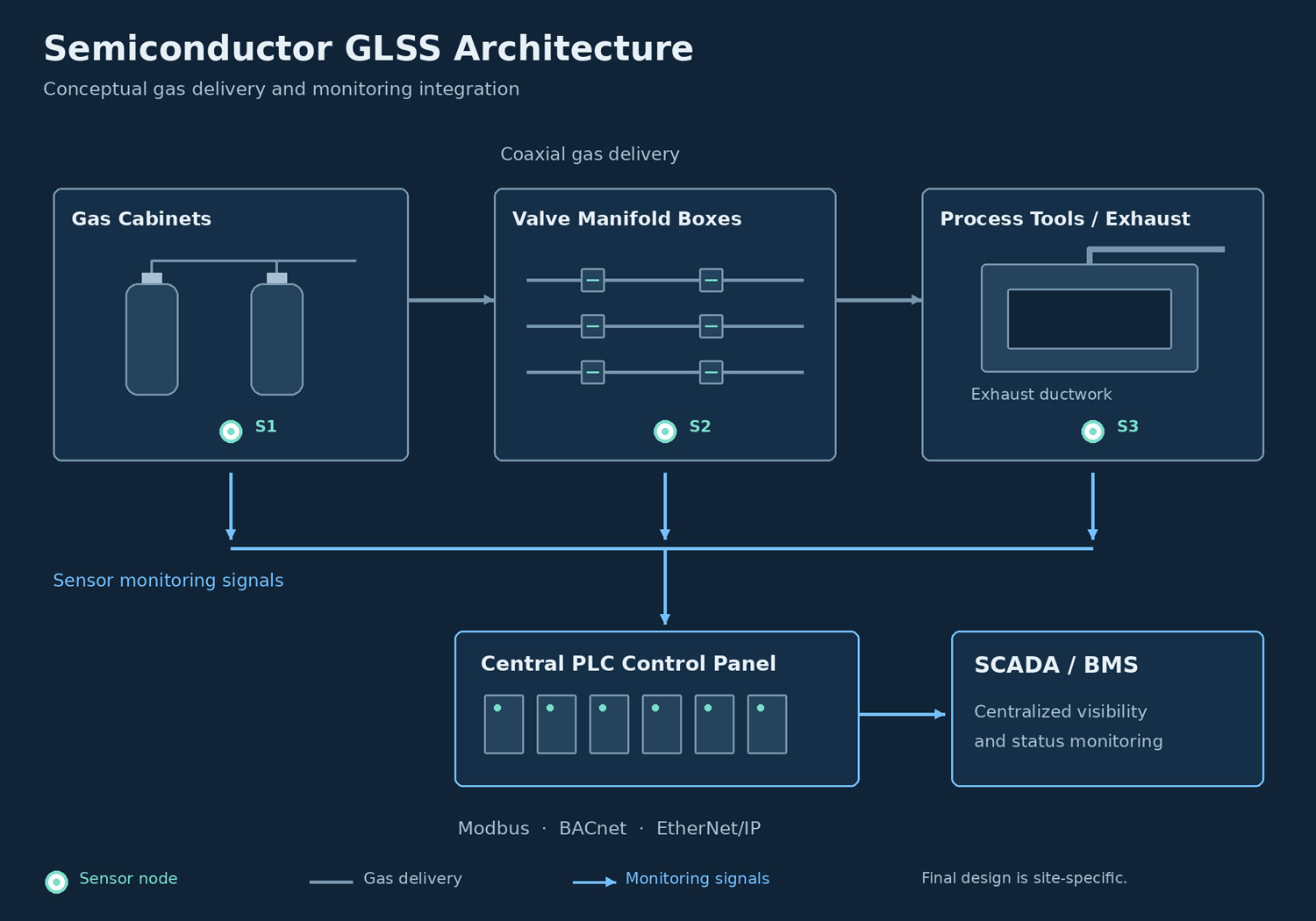
Specialty gases travel from bulk storage through gas cabinets and valve manifold boxes (VMBs), along coaxial delivery lines, through tool gas panels, and into process chambers. Leak potential exists at every transition point: coaxial fittings, VMB regulators, exhaust ductwork connections, and abatement system inlets. Monitoring a single area sensor in the gas room misses the majority of these failure modes. This creates blind spots.
Accurate detection at the fab level requires dual-technology deployment. Colorimetric paper tape systems provide ultra-low, interference-resistant detection of toxic hydrides like arsine and phosphine, where selectivity against common cleanroom chemicals matters as much as raw sensitivity. Electrochemical cartridges handle broader ppm-level monitoring for corrosive gases across the sub-fab and exhaust pathways. Organizations like Honeywell Semiconductor Gas Detection Solutions have built their semiconductor monitoring architectures around this layered approach, reflecting the operational reality that no single sensor technology covers the full hazard spectrum of a working fab.
False alarm prevention is where many systems fail in practice. Nuisance alarms disrupt production. Isopropyl alcohol, humidity swings, and solvent vapors common to cleanroom environments can saturate poorly selected sensors and trigger evacuations that have nothing to do with an actual hazardous gas release. Sensor technology selection and placement mapping are not afterthoughts: they determine whether a safety system protects operations or disrupts them.
Gas Life Safety Systems (GLSS) for Advanced Fabs
Safety requires precision.
MDC Systems engineers GLSS architectures from the hazard analysis stage through commissioning, managing the entire scope of what a semiconductor facility requires:
- Custom system design that integrates with existing SCADA and Building Management Systems (BMS) using standard industrial protocols to provide facility operators with centralized, real-time visibility of all sensor nodes.
- Tool-level sampling points installed inside gas cabinets, VMBs, and tool exhaust ducts to intercept leaks at the source before they migrate to occupied areas.
- Fixed ambient sensors deployed throughout the sub-fab, gas room, and cleanroom corridors for continuous personnel zone monitoring. This ensures continuous coverage.
- Intelligent PLC-based alarm cascades that initiate localized gas valve shutdowns before escalating to facility-wide evacuation protocols, preserving production continuity wherever the hazard boundary permits.
- System design aligned with SEMI S2 and SEMI S6 safety guidelines and local municipal fire code requirements, with documented commissioning records for regulatory review.
Engineering and System Integration Capabilities
A reliable GLSS requires more than equipment acquisition. Custom gas life safety system design encompasses initial hazard analysis, sensor placement mapping based on gas density and ventilation patterns, PLC programming, and full system commissioning with documented performance verification. MDC Systems manages that entire lifecycle, which means the system delivered is engineered for the specific chemical inventory, layout, and exhaust profile of your facility, not adapted from a template.
Communication architecture matters for operational visibility. MDC Systems designs systems using Modbus, BACnet, and EtherNet/IP protocols, enabling real-time gas concentration data to flow directly to the facility's central control room or SCADA network. Maintenance teams gain early warning diagnostics that allow them to address minor packing leaks in gas cabinets before those leaks escalate into safety events or production halts; this represents a meaningful difference in total cost of ownership compared to systems that only alert after a threshold breach.
Every fab has a unique layout, chemical inventory, and ventilation profile. Templates fail. Standardized hardware configurations sold by distributors without engineering support routinely create coverage gaps that only surface during an incident or a regulatory audit.
Localized Service and Lifecycle Maintenance in San Jose
Silicon Valley fabs and advanced battery R&D cleanrooms operate on rigorous production schedules that leave little tolerance for extended maintenance windows. Partnering with a local service provider based in San Jose, CA means rapid-response support when a sensor flags an anomaly at 2 a.m. or a scheduled calibration needs to be completed before a morning shift.
MDC Systems utilizes factory-trained technicians equipped with the specialized calibration gases, diagnostic tools, and documentation workflows required to service complex toxic gas monitoring systems (TGMS). Scheduled calibration programs are designed to be non-disruptive to active cleanroom operations, maintaining sensor accuracy and regulatory compliance without forcing production pauses. Documented calibration records are maintained in formats that satisfy Cal/OSHA inspection requirements, local fire authority audits, and insurance compliance reviews.
Scheduled maintenance also extends sensor service life and reduces premature cartridge replacements, a practical cost reduction that compounds over a multi-year maintenance contract. MDC Systems is a licensed, bonded, and BBB A+ rated contractor in San Jose, CA, reachable at 408-370-5005. We are always ready.
Advanced technology facilities throughout the San Francisco Bay Area, including cleanroom operations, next-generation manufacturing sites, and specialty gas research environments, have relied on MDC Systems for code-compliant, LEA-approved GLSS installations designed to meet Santa Clara County hazardous materials storage ordinances and local fire authority requirements. Each engagement involves a site-specific hazard analysis, not a catalog selection. Custom engineering is standard.
Facility managers in the planning or upgrade phase of their gas monitoring infrastructure can explore best practices for gas detection system integration before committing to a system architecture, particularly when SCADA compatibility and sensor technology selection are still open questions.
EHS Compliance and Risk Mitigation for Semiconductor Facilities
EHS Directors at California semiconductor operations navigate a regulatory environment that includes Cal/OSHA Title 8 standards, California Fire Code Chapter 60 requirements for highly toxic and pyrophoric materials, and regional environmental protection rules that vary by municipality. The compliance burden is not static. Local authorities having jurisdiction (AHJs) in Santa Clara County apply these standards with increasing scrutiny as fab chemical inventories grow.
A continuously monitored, professionally maintained GLSS serves as the primary documented defense against regulatory non-compliance, potential litigation following a release event, and the reputational and operational damage of a severe facility incident. Industry leaders such as DOD Technologies Semiconductor Fabrication Plants emphasize the integration of continuous fixed monitoring with portable verification tools as the standard for a complete, multi-layered safety posture; that posture is what local AHJs expect to see during permitting and inspection.
Facilities operating with continuously monitored, professionally calibrated Gas Life Safety Systems achieve a near-zero rate of undetected hazardous gas releases. Safety is measurable. That outcome is the established safety benchmark for continuous TGMS deployment, and it is what regulators, insurers, and operations leadership all require.
Frequently Asked Questions About Fab Gas Detection
A basic gas detector measures local gas concentration and triggers an alarm. This is insufficient. A GLSS is a fully integrated, code-compliant safety architecture that connects multiple sensor technologies across gas cabinets, VMBs, and exhaust ducts to a central PLC. That integration enables automated safety actions: shutting down emergency gas valves, activating secondary exhaust ventilation, and communicating directly with the facility's SCADA or BMS, rather than simply alerting someone to investigate.
Cleanrooms operate under tightly controlled environmental conditions where any evacuation or tool shutdown can ruin active silicon wafers, disrupt production schedules, and cost hundreds of thousands of dollars. Advanced detection systems use highly selective sensor technologies, such as colorimetric paper tape for toxic hydrides and specialized electrochemical cartridges for corrosives, to accurately differentiate target hazardous gases from common cleanroom chemicals like isopropyl alcohol, preventing costly nuisance alarms.
Sensors monitoring highly toxic and pyrophoric semiconductor gases require regular bump testing and scheduled calibration to maintain accuracy at sub-ppm detection levels. Because the consequences of sensor drift in these environments are severe, establishing a routine calibration program with factory-trained technicians is essential for both regulatory compliance and operational confidence.
Key monitoring targets include pyrophoric gases like silane, highly toxic hydrides like phosphine and arsine, corrosive gases like hydrogen chloride and fluorine, and asphyxiants like nitrogen, which is used in large quantities throughout sub-fab spaces and poses a genuine oxygen depletion risk in areas with limited ventilation.
MDC Systems designs custom systems using Modbus, BACnet, and EtherNet/IP communication protocols, enabling real-time data transmission from individual gas sensors and PLC controllers directly to your central SCADA or Building Management System. This provides facility managers with centralized visibility, rapid diagnostics, and automated logging for compliance audits, without requiring a separate monitoring interface.
Contact Us Today
Ensuring the safety, compliance, and operational continuity of your semiconductor facility starts with an engineering conversation, not a catalog order. We can help. Contact MDC Systems at 408-370-5005 to speak with an engineering partner about custom GLSS design, professional installation, or local calibration and maintenance support in San Jose, CA.