
Industries We Serve:
Gas Detection Across 10 Sectors
Facility managers, safety directors, and operations engineers in San Jose operate inside one of the most demanding regulatory environments in the country. Cal/OSHA enforcement is active, local fire codes in Santa Clara County are specific to occupancy classification, and the chemical footprints of high-tech and industrial facilities here are inherently complex. Choosing a gas detection partner who understands your sector's hazards, not just the general category of "gas monitoring," is the difference between a system that passes inspection and one that creates liability.
MDC Systems is a licensed, bonded, and insured life safety provider based in San Jose, CA, holding a BBB A+ rating. We design, install, and manage custom gas life safety systems engineered to the specific chemical profiles, occupancy classifications, and ventilation dynamics of each facility; we do not rely on off-the-shelf configurations adapted after the fact.
A gas detection system (GDS) does more than trigger an alarm. Properly designed, it continuously monitors for toxic, corrosive, flammable, pyrophoric, and asphyxiant gases, providing the early-warning margin that prevents employee and community exposure. This is a function the CDC study on toxic gas monitoring identifies as a core component of industrial safety programs. Determining the right sensor technology for each application requires understanding the trade-offs in sensitivity, selectivity, and response time that the CDC study on toxic gas monitoring documents across electrochemical, catalytic bead, infrared, paper-tape, and FTIR technologies; our gas detection methods resource covers those trade-offs in depth. Under federal OSHA and Cal/OSHA, employers carry a legal obligation to eliminate recognized hazards from the workplace, and a misconfigured or poorly maintained GDS does not satisfy that obligation.
Cal/OSHA's enforcement posture in Santa Clara County is not abstract. Violations carry steep costs. Cal/OSHA guidelines document a citation exceeding $212,000 issued against a San Jose sheet metal company for failures to maintain safe working conditions, a figure that reflects the agency's willingness to pursue substantial penalties when facilities fall short of required standards.
Schedule a technical consultation with MDC Systems to evaluate your facility's chemical inventory and design custom gas life safety systems built to pass local inspections the first time. Call 408-370-5005.
Semiconductor Facilities and High-Tech Manufacturing in San Jose
Semiconductor fabrication runs on gases that are simultaneously critical to process yield and hazardous to workers and the surrounding environment. The etching and CVD chamber-cleaning steps that define advanced chip production rely on high-GWP fluorinated gases: perfluorocarbons (CF4, C2F6, C3F8, c-C4F8), hydrofluorocarbons (CHF3, CH3F, CH2F2), nitrogen trifluoride (NF3), and sulfur hexafluoride (SF6), with nitrous oxide (N2O) also present in CVD and cleaning applications, per the EPA Semiconductor Industry Partnership. Under normal operating conditions, between 10% and 80% of these fluorinated gases pass through tool chambers unreacted and enter the exhaust stream if abatement systems are absent or underperforming, per the EPA Semiconductor Industry Partnership. That range is wide because emissions vary by gas species, equipment brand, and company-specific process parameters, which means a monitoring approach built around average assumptions will miss the actual risk profile of your specific tools. Averages hide real dangers.
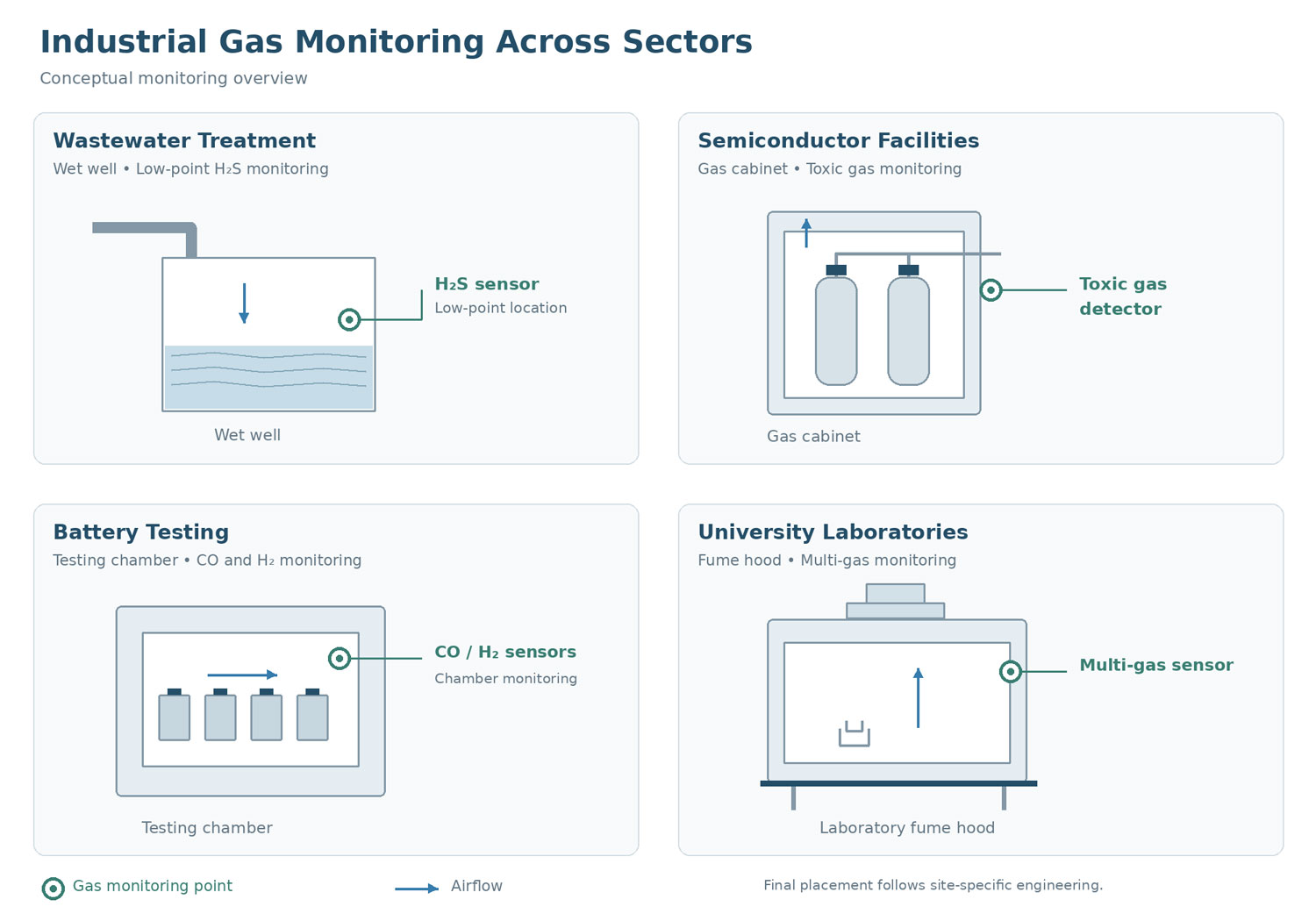
Continuous industrial gas detection at gas cabinets, valve manifold boxes (VMBs), tool enclosures, and abatement exhausts is the sole dependable method to catch releases before they reach occupied spaces or exceed permit thresholds.
Core Industrial Sectors and Gas Monitoring Solutions
Gas hazards across the nine additional sectors MDC Systems serves are as diverse as their processes. No two facilities are identical. Each requires sensor selection and placement logic specific to the target gas's physical properties, concentration thresholds, and the occupancy classification governing the space.
Wastewater Treatment Plants:
Hydrogen sulfide (H2S) accumulates in wet wells and lift stations; methane (CH4) builds in anaerobic digesters; chlorine (Cl2) and sulfur dioxide (SO2) present acute risks in disinfection areas. The corrosive and heavier-than-air nature of these gases demands low-point sensor placement and corrosion-resistant housings.
Battery Manufacturing and R&D:
Thermal runaway off-gases: carbon monoxide (CO), hydrogen (H2), and volatile organic compounds (VOCs) can accumulate rapidly in testing chambers. Facilities scaling from bench to pilot production need monitoring architectures that grow with the process without requiring a full system redesign.
University Research Laboratories:
Chemical inventories shift semester to semester. Flexible, multi-gas monitoring systems that protect against toxic, pyrophoric, and asphyxiant hazards without requiring a full redesign each time a lab's chemistry changes are the operational standard for these environments.
Chemical Processing Plants:
Bulk storage, process piping, and reactor areas handling volatile organic compounds and toxic feedstocks require continuous area monitoring with sensor redundancy at high-consequence release points.
Boiler and Chiller Rooms:
Carbon monoxide from combustion equipment and refrigerant vapors (HCFCs, HFCs) from mechanical chillers are the primary hazards. Sensor placement must account for the buoyancy differences between CO and refrigerant vapors to avoid coverage gaps.
Solar Panel Manufacturing:
Thin-film deposition and photovoltaic cell production introduce pyrophoric and toxic hazards, particularly silane (SiH4) and phosphine (PH3), which require fast-response sensors and tight alarm setpoints given their low permissible exposure limits.
Tunnels and Parking Garages:
CO and nitrogen dioxide (NO2) from vehicle emissions drive ventilation control logic. Monitoring in these spaces is as much about fan activation sequencing as it is about life safety alarming.
Landfill Sites and Biogas Facilities:
Methane (CH4) migration, carbon dioxide (CO2) accumulation, and hydrogen sulfide (H2S) in extraction wells and perimeter vaults require both fixed-point and perimeter monitoring strategies to capture subsurface migration patterns.
Sensitive-Receptor Occupancies:
Hospitals, schools, and care facilities cannot tolerate false alarms or delayed notifications. Low-level CO and refrigerant monitoring tied to automated ventilation overrides, with notification logic calibrated to the occupancy type, is the design standard for these environments.
Engineering Compliance and Local Fire Code Alignment
Santa Clara County's municipal codes impose specific gas monitoring mandates on facilities classified under the Uniform Building Code's Section 911 H-6 occupancy standards for semiconductor fabrication and Article 80 of the Uniform Fire Code; these requirements are documented in the CDC study on toxic gas monitoring. Navigating these codes in practice means designing systems that align with the local Fire Department's hazardous materials management plan (HMMP) and navigate the AHJ's plan-check process without revision cycles. MDC Systems designs to those exact municipal requirements, which is why our projects pass inspections without the costly retrofits that follow from a system engineered to a generic national standard rather than the local code environment. Local expertise prevents delays.
Compliance doesn't end at commissioning. Sensor drift, changing chemical inventories, and evolving process conditions can degrade a system's performance over time. Regular gas detection maintenance, which includes scheduled calibration, sensor replacement, and system audits, keeps the system performing to its original design specification. MDC's factory-trained technicians manage those programs so your compliance posture doesn't degrade between inspections.
End-to-End Life Safety Services from Design to Management
MDC's gas life safety system services encompass the entire project lifecycle: initial hazard assessment, custom system engineering, professional installation, and ongoing lifecycle management. Sensor selection and placement are derived from the specific chemical profiles of each facility, accounting for target gas buoyancy, airflow dynamics, occupancy classification, and process-specific release scenarios, rather than from a standard template applied across sectors.
A properly engineered system also reduces total cost of ownership in ways that aren't always obvious upfront. Minimizing false alarms extends sensor lifespans, reduces emergency service calls, and keeps operations running without unscheduled shutdowns. Operational continuity remains intact. MDC maintains current approvals with authorities having jurisdiction (AHJs) across San Jose, which means project submittals move through the approval process without the delays that come from working with a contractor unfamiliar with local requirements.
MDC's gas detection industry experience spans high-tech manufacturing, municipal infrastructure, and advanced R&D facilities throughout Silicon Valley. Specific client names are protected under non-disclosure agreements, but the systems MDC has deployed are trusted by leading technology and industrial operators across the region.
Call MDC Systems at 408-370-5005 to schedule an on-site system audit.
Frequently Asked Questions About Industrial Gas Detection
System selection, sensor technology trade-offs, and local compliance requirements are the three areas where facility managers most often need technical precision before committing to a monitoring architecture. Getting these parameters right from the start determines whether a system holds up under inspection and whether it performs reliably across the operational life of the facility.
The unreacted-gas problem in semiconductor manufacturing demonstrates why sensor placement and system design matter more than sensor count alone. Sensor placement is critical. Between 10% and 80% of fluorinated greenhouse gases used in semiconductor processes pass through tool chambers unreacted under normal operating conditions, per the EPA Semiconductor Industry Partnership. This range is wide enough that a single monitoring strategy cannot cover every facility's actual emission profile without a site-specific engineering assessment.
Gas Detection Compliance and Technology FAQ
Industrial gas leaks are detected using sensor technologies integrated into a centralized Gas Life Safety System (GLSS). Electrochemical sensors address toxic gases; catalytic bead and infrared sensors cover combustible hydrocarbons; photoionization detectors (PIDs) target volatile organic compounds. Sensor selection depends on the target gas species, required detection sensitivity, and the environmental conditions of the monitoring location.
Semiconductor facilities in Santa Clara County must comply with the Uniform Building Code's Section 911 H-6 occupancy standards and Article 80 of the Uniform Fire Code, as documented in the CDC study on toxic gas monitoring. These regulations mandate continuous monitoring in gas cabinets, VMBs, tool enclosures, and exhaust ducts to detect toxic, corrosive, and pyrophoric gases before they reach occupied spaces.
MDC's engineering process begins with a detailed review of your facility's chemical inventory, floor plans, and ventilation dynamics. Sensor technologies and placement locations are selected based on the physical properties of target gases, including buoyancy, concentration thresholds, and release scenarios. The system is then integrated with your building's PLCs, exhaust ventilation, and emergency shutdown systems.
To maintain continuous safety and compliance with Cal/OSHA guidelines, electrochemical and catalytic sensors typically require calibration every six months, while infrared sensors may support longer intervals depending on the application. MDC's factory-trained technicians manage detailed maintenance programs to maintain sensor performance and prevent false alarms.
Yes. MDC provides complete system documentation, calibration logs, and compliance audits that are inspection-ready. Systems are designed and maintained to meet or exceed all local municipal codes and Cal/OSHA guidelines, so facilities pass inspections without administrative penalties or operational delays.
Contact Us Today
MDC Systems brings sector-specific engineering expertise, current AHJ relationships, and a BBB A+ rating to every project in San Jose, CA. Whether you are commissioning a new monitoring system or auditing an existing installation, a gas detection system design consultation with MDC gives you a precise assessment of your facility's actual risk profile and the path to full compliance. Call 408-370-5005 to get started.