
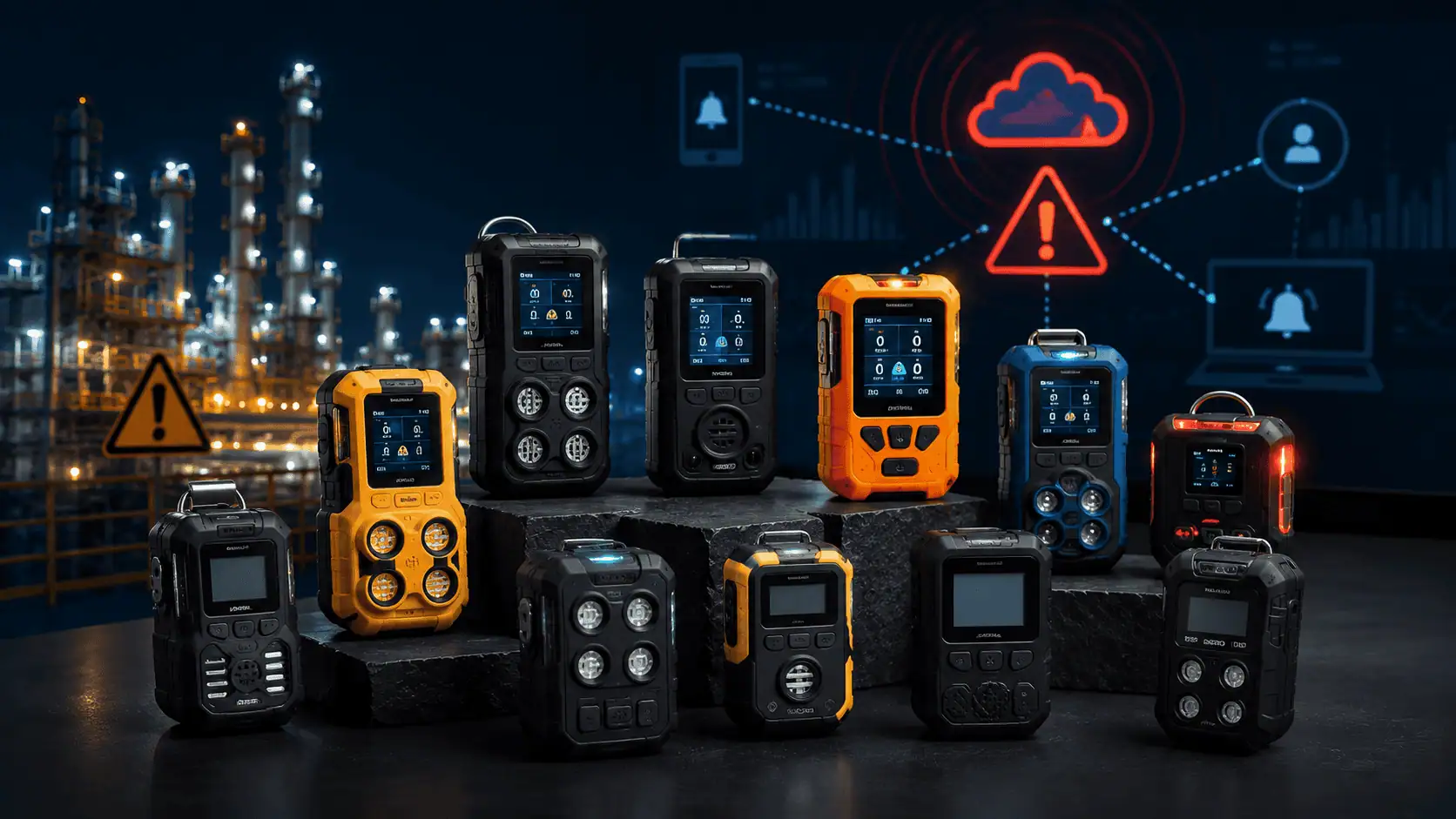
When safety managers ask, what are the most compact multi-gas detectors with real-time alerts, they are usually looking for more than a small device. They need reliable gas monitoring, fast alarms, manageable maintenance, practical battery life, and a system that fits the way crews actually work. In commercial and industrial environments, compact multi-gas detectors are especially valuable because workers can wear them in the breathing zone, carry them into confined spaces, and receive immediate warning when hazardous gases reach unsafe levels.
Multi-gas detectors commonly monitor oxygen, combustible gases, carbon monoxide, hydrogen sulfide, and other toxic or specialty gases, depending on the configuration. Some models focus on local real-time alerts through audible, visual, and vibration alarms. Others add Bluetooth, cellular, Wi-Fi, satellite, cloud dashboards, man-down notifications, GPS location, and fleet management software. The best choice depends on the hazards present, the work environment, compliance requirements, and how quickly supervisors need visibility into field conditions.
Below are 10 compact multi-gas detectors worth considering for modern gas life safety programs.
1. RKI GX-3R
The RKI GX-3R is one of the strongest choices for teams prioritizing size and weight. RKI describes it as the world’s smallest and lightest four-gas monitor, weighing only 3.52 ounces and measuring 2.2 inches wide by 2.55 inches high by 1.02 inches deep. It simultaneously monitors LEL combustibles, oxygen, carbon monoxide, and hydrogen sulfide, with audible, visual, and vibration alarms.
This detector is especially useful for confined space entry, maintenance teams, utilities, and industrial technicians who need a monitor that does not interfere with movement. It clips comfortably near the breathing zone and offers simple two-button operation, which helps reduce training time. RKI also notes IP66 and IP68 protection, a 25-hour lithium-ion battery, and a three-year warranty.
Best for: Workers who need the smallest practical four-gas monitor for daily personal protection.
Notable features:
- Four-gas monitoring for LEL, O2, CO, and H2S
- Extremely compact body
- Audible, visual, and vibration alarms
- Long battery life
- Water and dust resistance
2. Honeywell BW MicroClip Series
The Honeywell BW MicroClip Series is a widely used compact multi-gas detector known for its balance of size, simplicity, runtime, and affordability. Honeywell states that the MicroClip Series monitors up to four gases, including oxygen, hydrogen sulfide, carbon monoxide, and combustibles, with an 18-hour battery runtime in normal temperatures. It is also described as compact, lightweight, one-button operated, and IP68 rated.
For real-time local alerts, the MicroClip uses visual, audible, and vibration alarm methods. A distributor listing also notes that real-time gas concentrations are displayed, and alarms activate when thresholds are reached. The MicroClip X3 version includes a three-year warranty and an updated oxygen sensor, while the MicroClip XL remains a common choice for standard four-gas applications.
Best for: Facilities that want a familiar, compact, cost-conscious four-gas monitor with straightforward operation.
Notable features:
- Up to four-gas detection
- 18-hour runtime
- One-button operation
- IP68 protection
- IntelliFlash visual compliance indicator
3. MSA ALTAIR 4XR
The MSA ALTAIR 4XR is a rugged four-gas detector designed for demanding industrial use. MSA describes it as a tough four-gas monitor with rapid-response XCell sensors and real-time incident awareness when paired with the MSA ALTAIR Connect app.
This makes the ALTAIR 4XR a strong fit for teams that want compact portable protection with enhanced connectivity. The detector can serve workers in manufacturing, utilities, confined space entry, wastewater, construction, petrochemical, and maintenance environments. Its value is not only in alerting the wearer, but also in helping supervisors gain faster insight into incidents when connected workflows are used.
Best for: Crews that want a rugged four-gas monitor with app-enabled incident visibility.
Notable features:
- Four-gas detection
- MSA XCell sensor platform
- Real-time incident awareness with compatible app
- Rugged design
- Strong fit for industrial field work
4. MSA ALTAIR io 4
The MSA ALTAIR io 4 is a connected wearable gas detector designed for organizations that want real-time visibility beyond the worker wearing the device. MSA says the ALTAIR io 4 includes integrated cellular connectivity out of the box and delivers real-time visibility across workers, worksites, and workflows.
The ALTAIR io 4 is especially relevant for companies modernizing their gas detection programs with cloud-connected compliance and fleet management. It is built to work with MSA Grid and the ALTAIR io Dock, helping organizations manage testing, calibration, and device status more efficiently.
Best for: Companies that want compact gas detection with direct connectivity and centralized visibility.
Notable features:
- Integrated cellular connectivity
- Real-time worker and worksite visibility
- Compatible with MSA Grid
- Rugged wearable design
- Supports connected compliance workflows
5. Dräger X-am 2800
The Dräger X-am 2800 is a compact multi-gas detector that measures up to four gases. Dräger states that it is designed for personal monitoring and, when used with Dräger Gas Detection Connect software, supports live monitoring and fleet management.
This detector is a good option for safety teams that want a modern four-gas platform with data connectivity. A Dräger product page notes that the device can transfer recorded data via Bluetooth to a smartphone and then to the Gas Detection Connect backend, or transfer data directly to the cloud through the X-dock test station.
Best for: Facilities that need compact personal gas monitoring with Bluetooth-supported data workflows.
Notable features:
- Measures up to four gases
- Shock-resistant CatEx sensor
- Bluetooth data transfer
- Live monitoring through compatible software
- Fleet management capabilities
6. Industrial Scientific Ventis Pro5
The Industrial Scientific Ventis Pro5 is a compact five-gas monitor built for connected worker safety. Industrial Scientific describes it as a five-gas monitor that can connect workers for live monitoring, delivering real-time location data, man-down alarms, and gas alerts. It supports connectivity through cellular, Wi-Fi, or satellite when used with iNet Now live monitoring.
The Ventis Pro5 is especially valuable for remote work, turnaround operations, field service, utilities, emergency response, oil and gas, and any environment where the safety team needs to know who needs help and where they are located. It is more than a compact detector. It is part of a connected safety ecosystem.
Best for: Organizations that need real-time remote alerts, location awareness, and man-down notifications.
Notable features:
- Up to five-gas monitoring
- Live monitoring options
- Real-time location data
- Man-down alarms
- Cellular, Wi-Fi, and satellite connectivity options
7. Blackline Safety G7 Multi-Gas
The Blackline Safety G7 Multi-Gas is a connected wearable detector designed for fast incident response and long-term safety data insights. Blackline describes the G7 Multi-Gas as a wearable detector that monitors up to five gases and uses connectivity for fast incident response.
The G7c version is especially notable because it includes integrated cellular communication. A distributor listing describes it as a direct-to-cloud connected gas detector that streams bump test, calibration, and usage data to the Blackline Cloud. This makes it a strong choice for companies that want worker monitoring, compliance reporting, and gas detection in one connected platform.
Best for: Lone workers, field crews, and industrial sites needing cloud-connected safety visibility.
Notable features:
- Up to five-gas monitoring
- Cellular connectivity options
- Cloud-based data and compliance reporting
- Worker alerting features
- Strong fit for lone worker programs
8. Crowcon T4
The Crowcon T4 is a compact portable multi-gas detector for the four most common gas hazards. Crowcon states that the T4 provides portable detection for four common hazards in a simple, durable device designed to support compliance across multiple sectors and environments.
The T4 is a practical option for companies that want a rugged, straightforward detector without unnecessary complexity. It is designed for common four-gas protection, typically including oxygen depletion, flammable gases, carbon monoxide, and hydrogen sulfide, depending on configuration. A product listing describes the T4 as protecting against carbon monoxide, hydrogen sulfide, flammable gases, and oxygen depletion.
Best for: Teams that need simple, durable four-gas protection for everyday industrial use.
Notable features:
- Four common gas hazards
- Durable portable design
- Easy operation
- Suitable for compliance-driven programs
- Practical for harsh work environments
9. Teledyne GMI PS200
The Teledyne GMI PS200 is a compact, lightweight, water-resistant portable four-gas monitor. Teledyne describes the PS200 Series as a compact and lightweight detector that measures LEL, oxygen, carbon monoxide, and hydrogen sulfide.
The PS200 is well-suited for confined space entry and personal monitoring. A Teledyne store listing notes that it can measure any combination of LEL, O2, CO, and H2S and is available with an optional internal pump, making it useful for pre-entry testing as well as personal protection.
Best for: Confined space teams that need compact four-gas detection with optional pumped sampling.
Notable features:
- Four-gas monitoring
- Compact and lightweight design
- Water-resistant construction
- Optional internal pump
- Datalogging capabilities
10. GfG Microtector III G888C
The GfG Microtector III G888C is a compact multi-gas detector designed for personal protection in challenging environments, including confined spaces and shafts. GfG describes it as a compact detector that can include a catalytic combustion sensor, an infrared CO2 sensor, electrochemical toxic gas sensors, and oxygen sensing, depending on configuration.
The G888C is notable because some configurations can support more gases than standard four-gas monitors. Distributor information describes the G888 as one of the smallest and lightest four-to-seven gas detectors with a wireless module, and notes that wireless configurations can transfer current measurement data to a central device or operations center for real-time monitoring.
Best for: Facilities that need compact detection for more complex gas profiles, including specialty gas configurations.
Notable features:
- Four-to-seven gas detection options
- Compact design
- Wireless option for real-time monitoring
- Man-down status support in compatible configurations
- Flexible sensor combinations
How to Choose the Right Compact Multi-Gas Detector
The best detector is not always the smallest detector. A truly effective gas life safety program considers the entire operating environment, including gas hazards, alarm response, calibration needs, compliance records, device management, installation requirements, and long-term cost of ownership.
When comparing compact multi-gas detectors, consider:
- Gas profile: Identify whether your site needs standard four-gas detection or specialty gases such as ammonia, chlorine, sulfur dioxide, nitrogen dioxide, carbon dioxide, or VOCs.
- Alert type: Decide whether local alarms are enough or whether supervisors need remote real-time alerts.
- Connectivity: Evaluate Bluetooth, cellular, Wi-Fi, satellite, cloud dashboards, and SCADA or HMI integration needs.
- Battery life: Make sure the detector can support full-shift use in your actual operating temperatures.
- Calibration workflow: Consider bump testing, calibration intervals, docking stations, calibration gas availability, and documentation requirements.
- Durability: Review IP ratings, drop-test performance, hazardous location certifications, and chemical exposure risks.
- Cost of ownership: Factor in sensors, calibration gas, docking equipment, software subscriptions, maintenance, repairs, and equipment lead times.
- System integration: Determine whether portable devices must connect with fixed detection, alarms, ventilation, shutdown sequences, SCADA, or facility-wide GLSS architecture.
Why Compact Detectors Matter in Gas Life Safety Systems
Compact multi-gas detectors improve adoption because workers are more likely to wear devices that are lightweight, easy to understand, and comfortable during long shifts. However, portable monitors are only one part of a complete gas life safety strategy. Many commercial and industrial facilities also need fixed gas detection, alarm notification, ventilation controls, emergency shutdown functions, and integrated monitoring through I/O, SCADA, and HMI platforms.
For example, a semiconductor facility, wastewater plant, battery energy storage site, laboratory, manufacturing plant, or chemical storage area may need a combination of:
- Fixed gas sensors
- Portable multi-gas detectors
- Control panels
- Strobes, horns, and annunciators
- Ventilation or exhaust activation
- Gas cabinet or valve control
- SCADA or HMI visualization
- Calibration and maintenance programs
- Documentation for owners, authorities, and compliance teams
The right solution depends on the hazards, processes, building layout, code requirements, and operational risk tolerance.
FAQ: Compact Multi-Gas Detectors with Real-Time Alerts
What is a multi-gas detector?
A multi-gas detector is a portable or fixed device that monitors more than one hazardous gas at the same time. Common configurations detect oxygen, combustible gases, carbon monoxide, and hydrogen sulfide.
What does “real-time alerts” mean?
Real-time alerts usually refer to immediate alarms when gas levels reach preset thresholds. These alerts may include sound, flashing lights, vibration, app notifications, cloud dashboard alerts, man-down alarms, or remote supervisor notifications.
Are compact gas detectors as reliable as larger models?
Yes, many compact detectors are highly reliable when selected, configured, calibrated, and maintained correctly. The key is matching the device to the gas hazards, environmental conditions, and compliance requirements.
Which gases should my facility monitor?
That depends on your operations. Common gases include oxygen, LEL combustibles, carbon monoxide, hydrogen sulfide, ammonia, chlorine, sulfur dioxide, nitrogen dioxide, carbon dioxide, and VOCs. A professional hazard assessment is the best way to confirm your gas profile.
Do portable detectors replace fixed gas detection systems?
Usually, no. Portable detectors protect individual workers, while fixed systems protect rooms, equipment areas, process zones, and building occupants. Many facilities need both.
How often should multi-gas detectors be calibrated?
Calibration frequency depends on manufacturer instructions, regulatory requirements, site policies, sensor type, and exposure conditions. Many organizations also perform regular bump tests to confirm sensor and alarm response before use.
What is the difference between a bump test and calibration?
A bump test confirms that sensors and alarms respond to gas. Calibration adjusts the detector so readings remain accurate. Both are important parts of a reliable gas safety program.
Are connected gas detectors worth the investment?
Connected detectors can be valuable when supervisors need real-time visibility, location data, incident alerts, compliance records, or support for lone workers and remote crews. They may also reduce manual recordkeeping.
What should I consider before buying multi-gas detectors?
Consider the gas hazards, alarm needs, connectivity, battery life, maintenance requirements, certifications, software, calibration workflow, replacement sensors, and total cost of ownership.
Who can help design a complete gas life safety system?
A qualified GLSS provider can evaluate your facility, select appropriate equipment, design I/O functionality, integrate SCADA or HMI features, support approvals, install the system, and provide calibration and maintenance services.
Partner with MDC Systems, Inc. for Reliable GLSS Solutions
Choosing compact multi-gas detectors is only one part of building a dependable gas safety program. For commercial and industrial businesses, the larger goal is a gas life safety system that is properly designed, approved, installed, tested, calibrated, maintained, and integrated with your operational needs.
MDC Systems, Inc. specializes in customized gas life safety systems designed around each client’s unique hazards, facility layout, performance requirements, and budget. With more than 30 years of GLSS experience, we support design, engineering, system selection, I/O functionality, SCADA, HMI development, testing, installation, calibration, maintenance, and ongoing system management. Based in San Jose, California, we have served the greater Bay Area since 2010, now serve the entire State of California, and offer services across the United States.
We are fully licensed, bonded, and BBB-accredited with an A+ rating. We are committed to reliable, cost-effective, timely, LEA, and owner-approved solutions that prioritize safety, performance, and peace of mind.
For a customized GLSS solution, expert guidance, and a free estimate, contact us today.