
Confined spaces can present serious hazards, especially when oxygen levels are unsafe or toxic and combustible gases are present. That is why selecting the right gas detection devices for confined space entry is a critical part of protecting workers, maintaining compliance, and reducing operational risk. Whether the confined space is a tank, vault, pit, tunnel, manhole, process vessel, sewer, utility enclosure, or crawl space, atmospheric testing must be performed before entry and often continuously while work is underway.
Confined spaces are not always obviously dangerous. A space may look clean and accessible, yet contain oxygen-deficient air, flammable vapors, carbon monoxide, hydrogen sulfide, ammonia, chlorine, refrigerants, solvent vapors, or other hazardous gases. Because these hazards are often invisible and odorless, relying on human senses is not enough. Proper gas detection equipment provides the warning needed to make informed decisions before workers enter and while they remain inside.
For commercial and industrial facilities, gas detection is not just a matter of equipment selection. It is part of a larger life safety strategy that may include fixed gas detection systems, portable monitors, alarm notification, ventilation interlocks, supervisory controls, data logging, calibration programs, and maintenance support. Understanding the types of gas detection devices used for confined space entry helps facility managers, safety professionals, contractors, and operations teams choose the right tools for their specific environment.
Why Gas Detection Matters in Confined Spaces
A confined space is generally large enough for a worker to enter, has limited means of entry or exit, and is not designed for continuous occupancy. These spaces often have poor natural ventilation, which allows hazardous gases to accumulate or oxygen levels to drop. Conditions can change quickly due to work activity, chemical reactions, nearby processes, decomposition, welding, cleaning, or leaks from adjacent systems.
Gas detection is important because it helps identify hazards such as:
- Oxygen deficiency or oxygen enrichment
- Flammable gases and vapors
- Toxic gases such as carbon monoxide and hydrogen sulfide
- Process gases used in manufacturing or laboratories
- Refrigerant leaks
- Solvent vapors and volatile organic compounds
- Combustion byproducts
- Residual gases left behind after cleaning or maintenance
A safe confined space entry program typically includes testing the atmosphere before entry, monitoring during entry, and responding immediately if alarms occur. The right device depends on the gases of concern, space configuration, regulatory requirements, and the work being performed.
Portable Multi-Gas Monitors
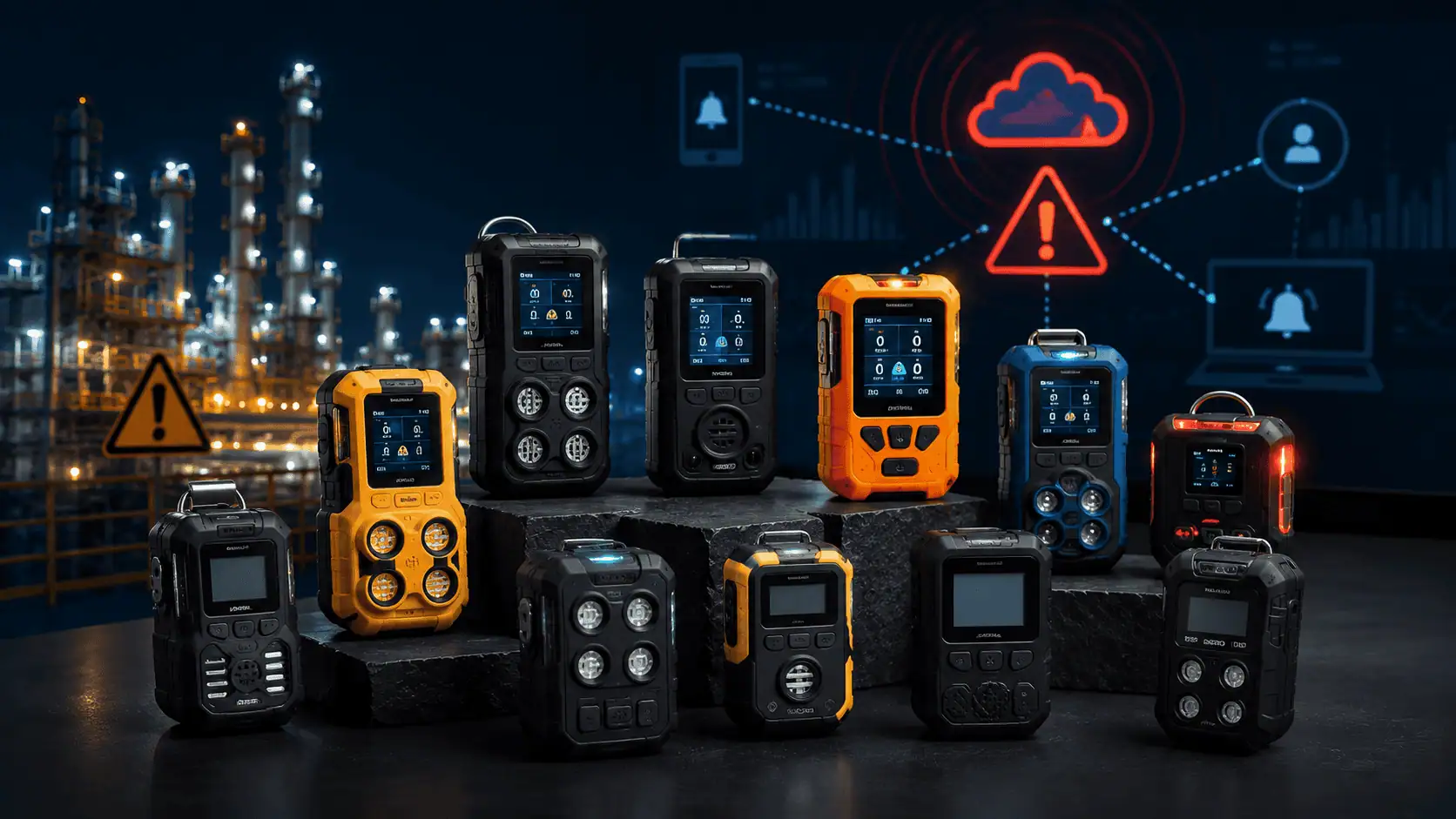
Portable multi-gas monitors are among the most common devices used for confined space entry. These handheld or wearable instruments typically detect multiple hazards at once, such as oxygen, combustible gases, carbon monoxide, and hydrogen sulfide. Many standard four-gas monitors are configured to detect:
- Oxygen
- Combustible gases measured as lower explosive limit
- Carbon monoxide
- Hydrogen sulfide
These monitors are widely used because they are compact, easy to carry, and suitable for many general confined space applications. Workers can wear them on their clothing, keep them near the breathing zone, or use them with sampling accessories before entry.
Portable multi-gas monitors are especially useful for maintenance teams, utility workers, construction crews, wastewater personnel, contractors, and industrial technicians who need real-time atmospheric readings. However, the monitor must be selected based on the expected gas hazards. A standard four-gas monitor may not be sufficient if the facility uses chlorine, ammonia, nitrogen dioxide, sulfur dioxide, refrigerants, oxygen-displacing inert gases, or specialty gases.
Pumped Sampling Gas Monitors
For many confined space entries, atmospheric testing must be performed before anyone enters the space. Pumped sampling monitors allow users to draw air from inside the space through tubing and into the detector. This makes it possible to test the atmosphere from outside the space before entry.
Pumped monitors are particularly valuable when:
- The space has a vertical entry, such as a manhole or vault
- The entry point is narrow or difficult to access
- Gas stratification is possible
- The worker needs to sample multiple levels of the space
- The atmosphere may be immediately dangerous to life or health
Gas stratification is an important concern. Some gases are lighter than air and may accumulate near the top of a space, while others are heavier than air and may settle near the bottom. A pumped monitor allows testing at different elevations before entry. This helps identify hazards that may not be detected from a single sampling point.
When using a pumped sampling monitor, users must account for tubing length, sample draw time, pump performance, filter condition, and sensor response time. Skipping these details can produce delayed or inaccurate readings.
Personal Gas Detectors
Personal gas detectors are worn by individual workers to provide immediate warning if hazardous conditions develop near the breathing zone. These can be single-gas or multi-gas devices, depending on the application.
Single-gas personal detectors are often used when one specific hazard is known, such as carbon monoxide, hydrogen sulfide, oxygen deficiency, ammonia, or chlorine. Multi-gas personal detectors are better when multiple atmospheric hazards may be present.
The key benefit of personal gas detectors is that they travel with the worker. In confined spaces, conditions can vary from one area to another. A fixed reading near the entrance may not represent the conditions deeper inside the space. A personal detector provides ongoing protection as the worker moves through the environment.
For confined space entry teams, personal monitors should be bump tested, calibrated according to manufacturer requirements, charged, inspected, and configured with appropriate alarm setpoints before use.
Fixed Gas Detection Systems
Fixed gas detection systems are permanently installed systems designed to continuously monitor specific areas for gas hazards. While portable devices are essential for many confined space entries, fixed systems can play a major role in facilities where confined spaces are part of routine operations or where hazardous gases are used, stored, or generated nearby.
Fixed systems may include:
- Gas sensors installed near tanks, rooms, pits, vaults, or process areas
- Controllers that receive signals from sensors
- Audible and visual alarms
- Ventilation controls
- Alarm relays and shutdown functions
- Integration with building automation systems
- SCADA and HMI interfaces
- Remote monitoring and notification capabilities
Fixed gas detection is especially valuable in industrial plants, laboratories, semiconductor facilities, battery rooms, wastewater treatment facilities, refrigeration plants, manufacturing environments, and chemical storage areas. These systems can provide early warning before a worker approaches or enters a hazardous space.
For confined spaces, fixed gas detection may be used to monitor the surrounding environment, verify ventilation effectiveness, or trigger alarms and controls when gas levels exceed defined thresholds. The system must be engineered for the gases involved, sensor placement, airflow patterns, alarm strategy, maintenance access, and authority requirements.
Area Gas Monitors
Area gas monitors are portable or transportable devices that can be placed near a confined space entry point or inside a work area to monitor atmospheric conditions. They are often used during temporary work, shutdowns, construction, maintenance, or emergency response.
Unlike personal monitors, area monitors are designed to protect a larger zone. Some models include loud alarms, flashing lights, wireless communication, and the ability to connect multiple units. They can alert attendants, entrants, supervisors, and nearby workers when conditions become unsafe.
Area gas monitors can be helpful when:
- Multiple workers are involved
- The job site changes frequently
- A fixed system is not installed
- Temporary monitoring is needed
- Confined space work is part of a larger maintenance or construction project
These monitors do not replace personal monitoring in many applications, but they can add another layer of protection.
Photoionization Detectors
Photoionization detectors, often called PIDs, are used to detect many volatile organic compounds and solvent vapors. They are especially useful when confined space work involves chemicals such as paints, coatings, fuels, degreasers, adhesives, or cleaning agents.
A standard combustible gas sensor may not detect low-level toxic solvent vapor hazards adequately. A PID can provide additional information when VOC exposure is a concern. However, PIDs are not universal gas detectors. They respond to compounds based on ionization potential and lamp energy, so they must be selected and interpreted carefully.
PIDs are commonly used in environmental work, industrial hygiene, hazardous material response, tank cleaning, and chemical processing environments.
Oxygen Sensors
Oxygen sensors are essential for confined space entry because oxygen levels can become unsafe without warning. A normal atmosphere contains about 20.9 percent oxygen. Confined spaces may become oxygen-deficient due to rusting, biological activity, combustion, displacement by inert gases, or chemical reactions. Oxygen enrichment can also increase fire risk.
Oxygen monitoring is important in spaces involving:
- Nitrogen or argon purging
- Welding or hot work
- Tanks and vessels
- Underground vaults
- Process equipment
- Wastewater systems
- Chemical storage areas
Workers should never assume a confined space has safe oxygen levels simply because it is open or recently ventilated. Oxygen must be tested with properly maintained detection equipment.
Combustible Gas Detectors
Combustible gas detectors measure flammable gases or vapors and usually report readings as a percentage of the lower explosive limit. These devices are used to detect gases such as methane, propane, hydrogen, gasoline vapors, and other combustible substances.
Combustible gas detection is vital before hot work, welding, cutting, grinding, or any activity that may create an ignition source. Even a small amount of flammable vapor in a confined space can create a serious explosion hazard.
Common combustible gas sensor technologies include catalytic bead sensors and infrared sensors. Each has advantages and limitations. Catalytic bead sensors can detect many combustible gases but may be affected by sensor poisoning or oxygen-deficient environments. Infrared sensors can be more resistant to certain contaminants and are often used for hydrocarbon detection, but they may not detect hydrogen. Selecting the correct technology matters.
Toxic Gas Detectors
Toxic gas detectors are used when specific gases may be present at harmful concentrations. Common toxic gases in confined space applications include:
- Carbon monoxide
- Hydrogen sulfide
- Chlorine
- Ammonia
- Sulfur dioxide
- Nitrogen dioxide
- Ozone
- Hydrogen cyanide
- Phosphine
Different industries have different toxic gas risks. Wastewater facilities may be concerned with hydrogen sulfide and methane. Parking structures and boiler rooms may involve carbon monoxide. Refrigeration systems may involve ammonia or refrigerants. Laboratories and manufacturing facilities may involve specialty gases.
Toxic gas detection should be based on a careful hazard assessment. The device must have the correct sensor, range, alarm settings, response time, and environmental rating for the application.
Calibration, Bump Testing, and Maintenance
Gas detection devices are only reliable when they are properly maintained. A monitor that is not calibrated, damaged, expired, contaminated, or incorrectly configured may provide a false sense of safety.
A strong gas detection program should include:
- Routine bump testing
- Scheduled calibration
- Sensor replacement as needed
- Battery and pump checks
- Filter inspection
- Alarm verification
- Documentation of test results
- User training
- Review of alarm setpoints and sensor ranges
Calibration and maintenance are especially important for organizations that rely on gas detection equipment for compliance, worker protection, and operational continuity. Maintenance should be performed by qualified personnel using the proper gases, tools, and procedures.
Choosing the Right Gas Detection Device
There is no single gas detector that is best for every confined space. The right choice depends on the hazards, facility design, regulatory requirements, and entry procedure. Before selecting a device, consider the following questions:
- What gases could be present?
- Could oxygen levels be deficient or enriched?
- Are combustible gases or vapors possible?
- Are toxic gases present or generated by the work?
- Does the space require pre-entry sampling?
- Is continuous monitoring required during work?
- Are alarms needed outside the space?
- Will the system need to integrate with ventilation, SCADA, or HMI systems?
- What calibration and maintenance support is required?
- What approvals or owner requirements must be met?
A proper gas detection strategy may include a combination of portable monitors, personal detectors, area monitors, and fixed gas detection systems. For complex facilities, customized gas life safety systems can provide a more complete and reliable solution.
The Role of Gas Life Safety Systems
Gas life safety systems, or GLSS, go beyond basic detection. They are designed to help protect people, property, and operations through engineered monitoring, alarms, controls, and system integration. A well-designed GLSS can improve safety by ensuring the right gases are monitored in the right locations, with the right alarm response and maintenance plan.
For commercial and industrial businesses, a customized GLSS may include gas detection design, engineering, equipment selection, installation, testing, calibration support, I/O functionality, SCADA integration, HMI development, and ongoing system management. This is especially important for facilities with complex hazards, multiple gas types, strict authority requirements, or mission-critical operations.
When designed correctly, a gas life safety system supports safer confined space entry and broader facility safety goals.
FAQ
What is the most common gas detector used for confined space entry?
The most common device is a portable multi-gas monitor. A typical four-gas monitor detects oxygen, combustible gases, carbon monoxide, and hydrogen sulfide.
Is a four-gas monitor always enough for confined space entry?
No. A four-gas monitor is useful for many applications, but it may not detect gases such as chlorine, ammonia, refrigerants, ozone, VOCs, or specialty process gases. The detector must match the actual hazards.
Should confined spaces be tested before entry?
Yes. The atmosphere should be tested before entry to identify oxygen hazards, combustible gases, and toxic gases. Many spaces also require continuous monitoring during work.
Why is pumped sampling important?
Pumped sampling allows workers to test the air inside a confined space before entering. It is especially useful for vertical spaces, deep spaces, or areas where gases may collect at different levels.
Do workers still need personal monitors if a fixed gas detection system is installed?
In many cases, yes. Fixed systems monitor specific locations, while personal monitors travel with the worker and provide breathing-zone protection.
How often should gas detectors be calibrated?
Calibration frequency depends on the manufacturer’s instructions, facility requirements, sensor type, and use conditions. Devices should also be bump tested according to the safety program and manufacturer guidance.
What gases are most dangerous in confined spaces?
Common hazards include oxygen deficiency, carbon monoxide, hydrogen sulfide, methane, propane, ammonia, chlorine, and solvent vapors. The specific risk depends on the facility and work activity.
Can ventilation replace gas detection?
No. Ventilation helps control hazards, but it does not replace atmospheric testing. Gas detection verifies whether the space is safe before and during entry.
Who should design a gas detection system for confined space safety?
A qualified gas detection and gas life safety systems provider should evaluate the hazards, sensor placement, alarm strategy, integration needs, maintenance requirements, and applicable approvals.
Partner With MDC Systems, Inc. for Reliable Gas Life Safety Solutions
Confined space safety depends on accurate detection, dependable equipment, proper system design, and ongoing support. We specialize in customized gas life safety systems designed to meet the unique needs of commercial and industrial businesses. With over 30 years of GLSS experience, we provide expertise in design, system selection, I/O functionality, SCADA, HMI development, testing, installation, calibration, maintenance, and ongoing system management.
Based in San Jose, CA, we have served the greater Bay Area since 2010 and now provide services throughout California and across the United States. We are fully licensed, bonded, and BBB-accredited with an A+ rating. We are known for reliable, cost-effective, timely solutions built around best known methods, long-term cost of ownership, equipment lead times, LEA and owner approval, and the safety performance clients rely on.
For gas detection system design, engineering, installation, testing, calibration, or maintenance support, contact us today. Request a free estimate and discover how a customized GLSS solution can deliver peace of mind, affordability, and dependable protection for your facility.